


Kant's Transcendental Idealism
Kant's Transcendental Idealism
The obscurity of Kant when it comes to his theory of empirical realism and transcendental idealism is largely due to his terminology and the difficulties of reconciling parts of his theory. Since "transcendental" is contrasted with "empirical," the two terms are epistemological and mean "independent of (i.e. transcending) experience" and "immanent in experience." Since "realism" is contrasted with "idealism," those two terms are ontological and mean "independent of my existence" and "dependent on my existence." Berkeley was for Kant the characteristic "idealist," and undoubtedly an empiricist, while Descartes was a "realist," believing commonsensically that objects exist independent of us, but who also thought that we could only know their essences through "clear and distinct" innate ideas, not experience. This made Descartes a "transcendental" realist.
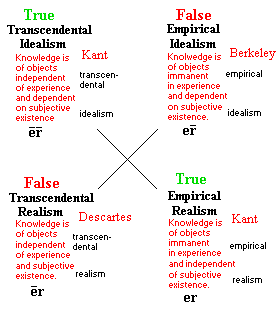 If
we try to construct a square
of opposition (http://www.friesian.com/syllog.htm) using Kant's two distinctions, we have some trouble.
A strictly constructed square of opposition would look like the
one at right. "Transcendental" (e) is the
negation of "empirical" (e), and "idealism"
(r) is the negation of "realism" (r).
The structure we get, however, does not work for Kant's theory.
Transcendental idealism and empirical realism would be contradictories
and so cannot both be true, as Kant requires. Similarly,
transcendental realism and empirical idealism are also contradictories
and so cannot both be false, as Kant requires. The features
of the square of opposition that we would expect Kant's theory to
conform to would be that "contraries," the two upper members,
are both false, while the "subcontraries," the two lower
members, are both true. If we want such a square of opposition,
it will have to be rearranged without regard for the strict logical
properties of the terms.
If
we try to construct a square
of opposition (http://www.friesian.com/syllog.htm) using Kant's two distinctions, we have some trouble.
A strictly constructed square of opposition would look like the
one at right. "Transcendental" (e) is the
negation of "empirical" (e), and "idealism"
(r) is the negation of "realism" (r).
The structure we get, however, does not work for Kant's theory.
Transcendental idealism and empirical realism would be contradictories
and so cannot both be true, as Kant requires. Similarly,
transcendental realism and empirical idealism are also contradictories
and so cannot both be false, as Kant requires. The features
of the square of opposition that we would expect Kant's theory to
conform to would be that "contraries," the two upper members,
are both false, while the "subcontraries," the two lower
members, are both true. If we want such a square of opposition,
it will have to be rearranged without regard for the strict logical
properties of the terms.
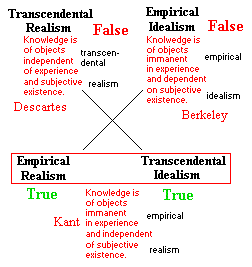 When
we do that, we then get a square like the one at right. In this
version the definition of "transcedental idealism" has
actually been left out. Kant's position, although terminologically
embracing the two lower members, is really well defined by only
one of them, empirical realism. However, saying that the objects
of knowledge are immanent in experience and independent of
our existence involves a paradox. How can something be independent
in existence and yet dependent or immanent in our experience, our
representation?
When
we do that, we then get a square like the one at right. In this
version the definition of "transcedental idealism" has
actually been left out. Kant's position, although terminologically
embracing the two lower members, is really well defined by only
one of them, empirical realism. However, saying that the objects
of knowledge are immanent in experience and independent of
our existence involves a paradox. How can something be independent
in existence and yet dependent or immanent in our experience, our
representation?
...the representation alone must make the object possible... ...representation in itself does not produce its object in so far as existence is concerned... [A 92]
The common sense, direct acquaintance with objects, part of this is what Kant appears to mean by his empirical realism, while the paradoxical, "in me but not of me," metaphysics is what he means by "transcendental idealism." This is the paradox addressed by Schopenhauer and by "Ontological Undecidability (http://www.friesian.com/undecd-1.htm)."
However, using the strict definitions, "transcendental idealism"
means something else, as reproduced in the entry at left. 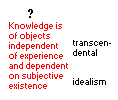 If
"transcendental" means, epistemically, "independent
of experience," but "idealism" means, ontologically,
"dependent on subjective (my) existence," then "transcendental
idealism" would have to mean knowledge of objects that are
dependent on my existence but independent of my experience. This
seems to be, not just a paradox, but an out and out contradiction,
since if something exists as an epiphenomenon of myself, it hardly
seems like it could be independent of my experience. Berkeley's
principle was "to be is to be perceived," but this kind
of "transcendental idealism" would require that something
is because of my existence but then is not perceived. This might
work on the basis of Spinoza's metaphysics, where my existence is
God's existence, but God's knoweldge far transcends mine. Nevertheless,
since anything is God, God is part of my experience after all.
If
"transcendental" means, epistemically, "independent
of experience," but "idealism" means, ontologically,
"dependent on subjective (my) existence," then "transcendental
idealism" would have to mean knowledge of objects that are
dependent on my existence but independent of my experience. This
seems to be, not just a paradox, but an out and out contradiction,
since if something exists as an epiphenomenon of myself, it hardly
seems like it could be independent of my experience. Berkeley's
principle was "to be is to be perceived," but this kind
of "transcendental idealism" would require that something
is because of my existence but then is not perceived. This might
work on the basis of Spinoza's metaphysics, where my existence is
God's existence, but God's knoweldge far transcends mine. Nevertheless,
since anything is God, God is part of my experience after all.
What this peculiar meaning of "transcendental idealism"
reveals, along with the failure of the strict square of opposition,
are
the loosest ends of Kant's thought. The terminology of "transcendental,"
"empirical," "realism," and "idealism"
does not seem well ordered for Kant's purposes, in part because
those purposes are unsettled. The contradiction of the strict rendering
of "transcendental idealism" might be resolved if we say
that there is simply no knowledge in this case, which is
pretty much what Kant says about things-in-themselves -- the soul
certainly depends on my existence but is not part of my experience
because I don't have any knowledge of it. But then Kant doesn't
want to go all the way with that. Morality doesn't fit into empirical
reality, but then maybe that isn't too bad, since morality is really
"regulative" rather than "constitutive" (of
metaphysical entities). What is bad are "God, freedom, and
immortality," which totally upset the applecart. If there are
such things, they are about transcendent objects which, at least
in one case, are independent of my existence. If they are only objects
of "faith," we want to know how that is motivated; and
if they are motivated as necessary conditions of the Moral Law,
then it seems like they would be as much matters of knowledge as
the necessary conditions of experience, i.e. causality, substance,
etc.
Originally from friesian.com (http://www.friesian.com/kant.htm)


My Books

